COMMODORE 64 · PAL · 2026 · VERSION 1.1

The Reversing Ballet

Reverse an articulated truck into a loading bay without touching a wall – then try it with two trailers, and then with three. The trailers swing the opposite way, and learning to dance with them is the whole game.

Free. Runs on a real C64 or in an emulator such as VICE. 12 levels, joystick or paddle. Version 1.1: paddle calibration and a double press to change direction.

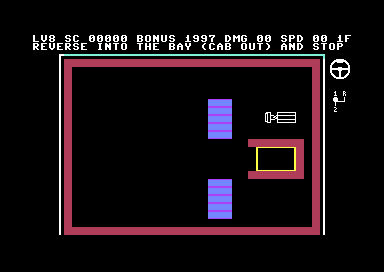
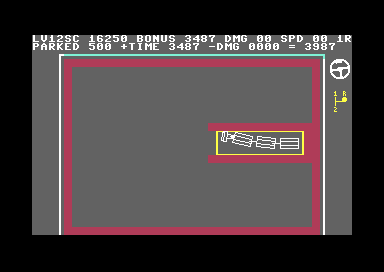
Level 12: the truck and three trailers parked in a long yellow dock; the message line shows the score for the level.
Level 12: three trailers, parked – after an S-bend and two shunts to straighten the train. Score = 500 + time bonus − damage.

What it is

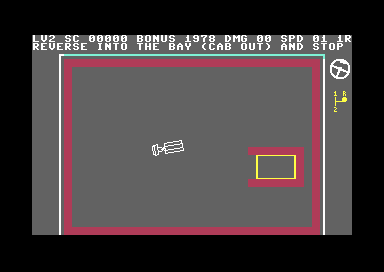
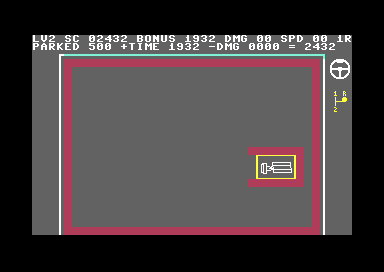
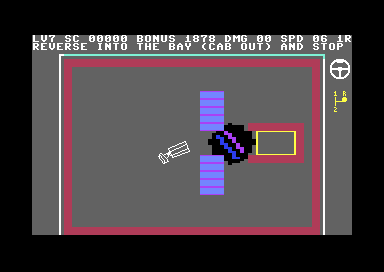
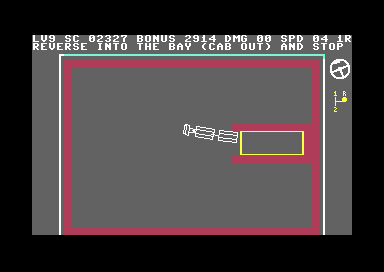
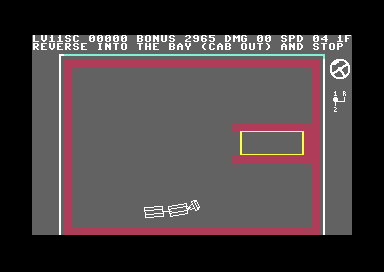
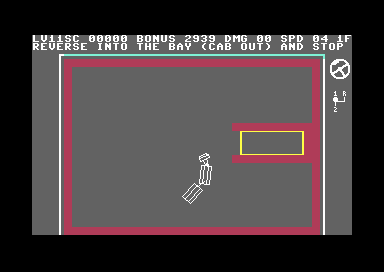
The Reversing Ballet is a parking game. Each level is a walled yard seen from above, with a yellow bay at the end of it. Drive the truck in, reversing, and stop with the cab facing out. Hitting a wall or a parked truck costs damage; ten damage ends the game. The faster you park, the bigger the time bonus.

It's built on a real piece of 8-bit history. The truck – its outline, its steering and above all the way its trailer swings – comes from Juggernaut, a 1985 ZX Spectrum game written by Pete Cooke and published by CRL. We took the Spectrum program apart, ported its truck to the C64 exactly, and built a new game around the part that was always the most fun: getting that trailer to go where you want it.

Why make it

Reversing a trailer is a genuinely hard, genuinely satisfying skill: to send the trailer left you steer right, and every correction you make shows up a moment later, a bit bigger than you wanted. Juggernaut modelled that properly in 1985, on a 3.5 MHz machine. The idea behind this project was to give that physics a game of its own, on the C64, running smoothly – and then to keep raising the bar with longer trains.

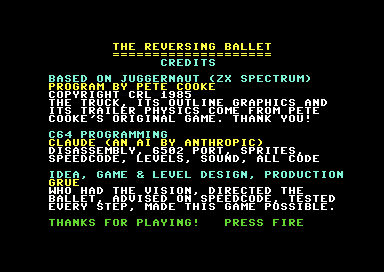
It's also an experiment in how far a human and an AI can take a retro project together: the idea, game and level design and the testing by grue; the disassembly, porting and all the 6502 code by Claude, an AI by Anthropic.

Screenshots

How to play

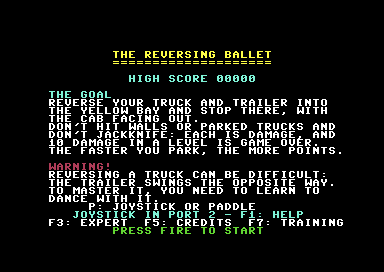
Reverse into the yellow bay and stop, cab facing out. Driving in forwards doesn't count – the game tells you to turn round.

Joystick, port 2Does
left / rightsteer (the wheel returns to the middle when you let go)
up / downaccelerate / brake
fire or SPACEgear 1 ↔ 2; when stopped, forward ↔ reverse; start the level

Paddle, port 2Does
knobthe steering wheel – it follows the knob
button heldaccelerate; let go and the auto brake slows the truck (strength 0–4, set when calibrating)
double presschange direction: the truck stops, then switches forward / reverse (hold the second press to drive off)
SPACEgear, forward/reverse, start

Keys

Ptitle: joystick or paddle (the paddle opens its calibration page)
F1help page (the game pauses)
F3title: start at the expert levels (9–12)
F5title: credits
F7title: training – no score, no game over, + skips a level; near a jackknife it tells you which way to turn to straighten the cab
RETURNrestart the level
RUN/STOPquit to the title screen
(15 s)title left alone: a demo drives one level, the next one each time; any key or fire ends it

The levels

Levels 1–8 use one trailer and add tighter bays, gaps between parked trucks, narrow alleys and oil. Levels 9–11 hitch a second trailer, level 12 a third. More trailers are heavier – speed changes far more slowly, both speeding up and braking – and they get a bigger time bonus.

How it was made – and what hurt

The project started as a straight port of Juggernaut and turned into a game of its own. These are the main steps, with the problems that cost the most time.

  1. Taking the Spectrum game apart

    The tape image was unpacked into its loader and the 40 KB game block, then disassembled into a labelled Z80 source with SkoolKit. Which bytes are code and which are data was worked out from emulator traces of the title, the town map and driving. The rebuilt source reassembles byte for byte into the original.

    Pain: about 7.7 KB of code mixed with tables, jump tables and graphics. Without traces, a disassembler happily "decodes" data as instructions.

  2. A bit-exact truck on the 6502

    The truck's physics – an articulated tractor and trailer in fixed point – was rewritten in 6502 and checked against the original Z80 code running in an emulator. After every update the two must agree on every byte of the state: heading, trailer angle, position, speed.

    Pain: the Z80's 16-bit arithmetic and the Spectrum's rounding had to be copied exactly. "Close" isn't good enough, because the trailer amplifies every difference.

  3. Drawing a rotating truck in sprites

    The Spectrum draws the truck as software graphics. On the C64 its outline is drawn line by line into a 48×42 block of four hardware sprites, double-buffered so you never see half a picture. The drawing code is generated per angle – long runs of plain stores, no loops – and a finished image is reused while the angles don't change.

    Pain: a turning truck still costs up to ~27,000 CPU cycles to draw, more than a whole frame. That decided the update rate.

  4. A game around the truck

    Walled bays you have to reverse into, damage, a time bonus, oil, a title page and a help page, a steering wheel and a gear selector, SID engine sound, a training mode and credits. Levels are checked with an automatic driver: a feedback "player" that steers the real game code in a 6502 emulator until the truck is parked, so a level is known to be solvable before anyone plays it. Those proven drives, packed to a byte per step, are also the demos the title screen plays after 15 seconds.

    Pain: the original's 22.5° steering lock made reversing hopeless – a bent trailer swings faster than the cab can follow. It became 45°, with a self-centring wheel. And very slow turns used to vanish entirely, because the original's division dropped the remainder each update; carrying it over fixed "the truck goes straight back no matter what I do".

    Pain: the demos replayed perfectly in the emulator used for testing, yet in the real game a level sometimes drove differently. A few physics counters (the trailers' mass timing, the oil grip) were never reset, so a level played slightly differently depending on how the one before ended. Now every level starts from the same state.

  5. Two trailers, then three

    The extra trailers can't be drawn at run time – there's no time left – so every one of their 128 angles is precalculated as a pair of sprites placed wherever they fit best. At run time a trailer only needs a 128-byte copy, and only when its angle step changes. The third trailer reuses the second one's pictures.

    Pain: the C64 has eight sprites. The truck takes four, two trailers four more, and the oil patches and the steering wheel wanted some too. The wheel and gear selector first shared one sprite via a raster split, and in the end became characters, which freed the last two sprites for the third trailer. Oil stays off the trailer levels.

  6. Making it feel right

    A jackknife between trailers is now a solid bump that stops the truck, instead of a clamp that dragged a trailer sideways ("it slips!"). Trailers have mass: speed changes only every 6th update with two of them, every 10th with three. The first, gentler settings were "hardly felt".

    Pain: what looks like a big change on paper can be invisible at 25 updates per second. Tuning took real play, in VICE, by a human.

The demo runs – and how hard they were

Written by Claude, who made them. grue asked for an honest account.

Leave the title screen alone for 15 seconds and the game drives one level by itself – the next level each time, all 12 in turn. Nobody played these drives. Each one is a list of joystick inputs, one per update (25 a second), found by programs on the PC that drive the real game code in a 6502 emulator until the truck is parked. The game replays the list, so a demo is exactly as good as the search that found it. Packed one byte per run of equal inputs, the 12 demos take 3,966 bytes, squeezed into three free corners of memory with about 330 bytes to spare.

You can tell they're machine-made: the steering taps left, centre, right almost every update – it's a feedback controller, not a person – and the routes are often not the ones a human would choose.

How it went

When grue moved the start positions of several levels and added oil to two more, nine of the twelve stored drives no longer worked (two of them had been broken for a while already). The automatic driver can only back into a bay from roughly in line with it, so for each level I wrote a search: random forward routes – a few waypoints for the truck to drive through – each followed by the reversing driver, about 4,000 tries per level spread over 44 processor cores. Levels 1, 4, 5, 7 and 9 fell out of that within minutes; level 6, a narrow alley, needed a rough route sketched by hand that the search then varied.

Level 8, the oily yard, needed a hand-drawn route too – over the top of a parked truck and back through the gate – which the search then fine-tuned. Level 3 has its gap between the parked trucks completely blocked, which leaves a 40-pixel corridor in front of the bay; the reversing driver can't start from there at all. I added a scripted full-lock swing before the driver takes over and searched its length, speed and starting point.

My mistake: the driver only checked for collisions, not for the damage counter. So three of my first "solutions" (levels 3, 6, 7) quietly took a jackknife damage point. I first assumed the real game and the test emulator disagreed and spent a long time comparing memory dumps between them – including one trace comparison that was off by a step, which sent me looking for a difference that wasn't there. In the end both emulators agreed perfectly; my driver was simply accepting a damaged run. Now any damage fails a run, and every demo parks with 0 damage.

But: that hunt did find real game bugs. Two counters – the trailers' mass timing and the oil grip – were not reset when a level started, so a level drove slightly differently depending on how the previous one ended, and the trailer's cached sine and cosine also came from the previous level for the first step. All three are now reset.

Level 12 – the hard one, in detail

Level 12 pulls three trailers. The whole train is 78 pixels long, the bay is 88 pixels deep, and the new start puts the train 32 pixels above the bay's line, already over the bay and facing away from it. So the train has to be driven forward out to the left, brought down 32 pixels, and reversed back in dead straight.

  • First, the automatic driver had no idea about a third trailer: it controls the second trailer's tail through the cab, and with three the last trailer just wanders. I wrote a third control loop – lateral error behind trailer three, to the wanted angle of trailer three, to the wanted angle between trailers two and three, and on down to the steering.
  • 4,000 random routes: none parked.
  • Second idea: an S-bend forward, then reverse with the wheel straight – the way the old level 12 was solved. It fails because forward driving straightens a three-trailer train only slowly. The bend can't start until the last trailer has cleared the bay's top-left corner, and by the time the cab reaches the left wall the trailers still lie at an angle. The yard is not long enough.
  • Third: an evolutionary search over the route and all eleven control gains at once. After twelve generations it reported success – and the replay failed. That was my error: in the scoring, any negative value counted as "parked", and the truck overshooting its target point also gave a negative value. It had never parked. I removed that route and fixed the scoring.
  • With honest scoring the search stalled (best score around 100, where 0 means parked), both for one-pass routes and for routes with shunting – driving forward again part way to straighten the train, like a real driver. Watching the best failures showed why: every forward bend left the trailers pointing down and to the left, so reversing carried the whole train up and to the right, away from the bay line, every time.
  • The fix was to let the routes overshoot: drive down well past the bay line, so that reversing brings the train back up onto it. With that allowed, the search found a drive in three generations – an S-bend that overshoots, then two shunts, then the final reverse. It parks with 0 damage after 1,284 updates, about 51 seconds: by far the longest demo.

To be honest about what that is: the level-12 demo proves the level can be done, but it isn't a model of how to do it. Its control gains were tuned by the search for this one start position, the drive is fussy and very long, and any later change to the physics would almost certainly break it. A human will probably find a cleaner way – or decide the start should sit a little lower.

Every demo was then replayed in VICE, all twelve in a row the way the title screen plays them, and each one parked with 0 damage before the cycle wrapped round to level 1 again. The test suite – 373 checks, including "each level's stored solution parks" – passes. The gameplay video uses the same drives: a special build of the game presses the keys around the levels and lets the demo drives do the driving.
Making it run as well as it does

8 → 25updates per second: the Spectrum's pace vs. the C64 version
35KCPU cycles in the slowest update with three trailers, of a ~38K budget
50 → 23 KBgame packed for loading, unpacks in about 1 second
0late updates in a VICE stress run with three trailers turning hard

Download

▼ reversing_ballet.d64

▼ reversing_ballet.prg

In VICE

Drag the .d64 (or the .prg) onto the VICE window, or start it with x64sc -autostart reversing_ballet.d64. Give it a joystick in control port 2. For the paddle, set control port 2 to Paddles and press P on the title screen; the mouse turns the knob. The calibration page asks for the knob turned fully right and then fully left, each with a press of the paddle's button.

On a C64

Write the image to a floppy, or use an SD2IEC, a 1541 Ultimate or similar, then:

LOAD"*",8,1  and  RUN

Changes

  • 1.1 (27 October 2026) – Paddle calibration page: press P on the title, turn the knob fully right and fully left with a press of the button each time; the live knob and button readouts let you test the paddle. The auto brake (button released) has a strength of 0–4 (+ on the calibration page). Double press the paddle button to change direction: the truck stops, then switches forward / reverse. The calibration page says the paddles go in control port 2. Training mode hints which way to turn to straighten the cab when it bends towards a jackknife.
  • 1.0 (22 October 2026) – First release: 12 levels, expert levels with two and three trailers, training, title-screen demos, joystick or paddle.

PAL machine recommended (the speed is tuned for 50 Hz). Loading the 98 blocks takes about a minute on a stock 1541 and about 10 seconds with JiffyDOS – the disk is laid out (sector interleave 6) for JiffyDOS, measured in VICE. The game then unpacks itself in about a second.

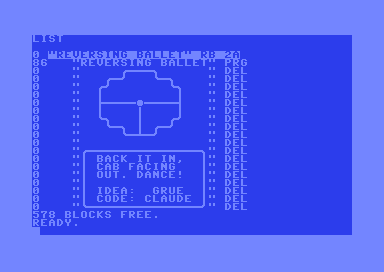
Disk directory listing: the game file, then a steering wheel and a note card drawn with PETSCII characters.
The disk's directory: the game, a steering wheel and a note, drawn with PETSCII.